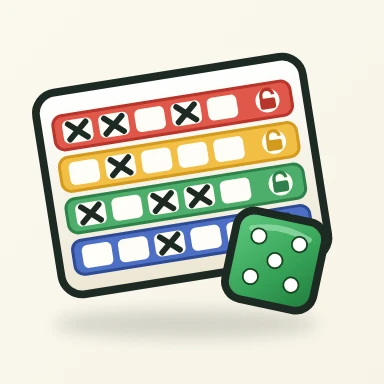
How many points in Qwixx? Scoring 1, 3, 6, 10… and 9 printable score sheets
- Dice
- 6: 2 white and 4 coloured
- Scoring
- 1, 3, 6, 10, 15… up to 78
- Failed throw
- −5 points
- Game end
- 4 failed throws or 2 rows locked
In short
In Qwixx, each player crosses off numbers in four coloured rows, always from left to right. At the end of the game, each row scores according to its number of crosses: 1 cross is worth 1 point, 2 crosses 3 points, 3 crosses 6 points, 4 crosses 10 points, up to 78 points for 12 crosses (the 11 numbers and the lock). Each failed throw costs 5 points. Add up the four rows, subtract the penalties, and the highest total wins.
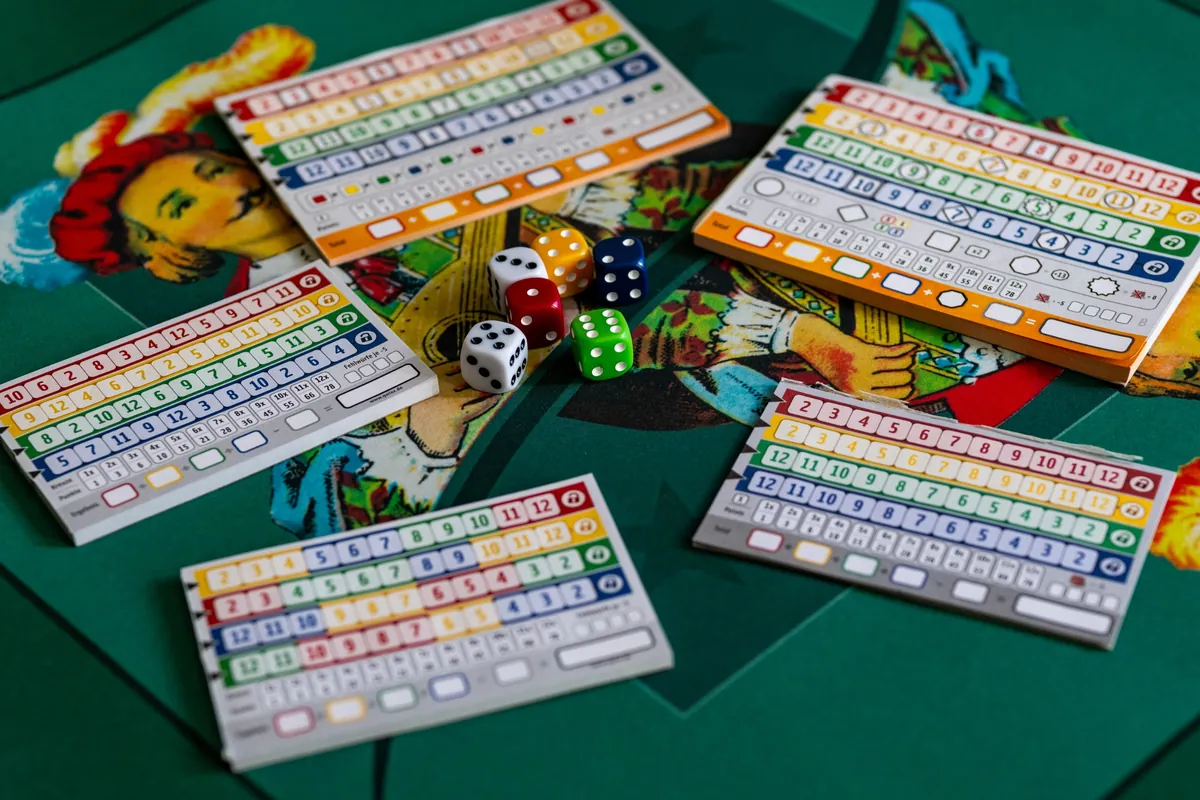
Names and editions. Qwixx keeps the same name in every language. In the United States, the game is published by Gamewright.
How it works
Qwixx is played by 2 to 5 players with six dice: two white and four coloured (red, yellow, green, blue). Each player has their own score sheet with four rows: red and yellow run from 2 to 12, green and blue from 12 to 2. You cross off numbers from left to right; you may skip boxes, but a skipped box can never be crossed later.
On their turn, the active player rolls all six dice. Two actions follow, in this order:
- The two white dice: the active player announces their sum, and every player may cross off that number in the row of their choice.
- One white die and one coloured die: the active player alone may add one white die to one coloured die and cross off the sum in the row of that colour.
The active player may take both actions, just one, or neither. If they cross off nothing at all during their turn, they mark a “failed throw” box. The other players are never penalised for passing.
The scoring
| Crosses in the row | Points | Crosses | Points |
|---|---|---|---|
| 1 | 1 | 7 | 28 |
| 2 | 3 | 8 | 36 |
| 3 | 6 | 9 | 45 |
| 4 | 10 | 10 | 55 |
| 5 | 15 | 11 | 66 |
| 6 | 21 | 12 | 78 |
Each extra cross is worth one point more than the one before: the row scores 1 + 2 + 3 + … up to its number of crosses. The lock crossed when you close a row counts as a cross. Each failed throw takes away 5 points.
This scoring rewards long rows: two rows of 6 crosses are worth 42 points, a single row of 12 crosses is worth 78. So it pays to focus on two or three colours rather than crossing a little everywhere.
Locking a row
The last box of a row (12 for red and yellow, 2 for green and blue) can only be crossed if you already have at least 5 crosses in that row. When you cross it, you also cross the lock next to it, which counts as one more cross: the row is locked.
The die of that colour leaves the game: nobody can cross anything in that row any more, even players who had almost nothing in it. Announce it out loud. If several players cross the same last box with the white dice, they lock the row together and each crosses their own lock.
Game end
The game ends immediately in two cases:
- a player marks their fourth failed throw;
- two rows are locked (two coloured dice have left the game). A row locked during the white-dice action can be followed by a second one in the same action.
Everyone then works out the points of their four rows with the scoring table, subtracts 5 points per failed throw, and the highest total wins.
Nine printable score sheets
We have redrawn the classic sheet and the most played variants, and created two brand-new sheets to keep games fresh. All of them are played with the dice from the box, and the app’s counter applies their rules:
| Sheet | What changes |
|---|---|
| Classic | The standard sheet |
| Doubles | Four boxes per row are worth two crosses; you need 7 crosses to lock |
| Encore | You may cross your last box again when its number comes up; 7 crosses to lock, 16 crosses count at most |
| Chain bonus | A framed box gives a free cross in the colour shown by the bonus bar |
| Powers | Five symbols, two boxes each: 2 extra crosses, 1 cross in every row, a row that scores double, +13 points, failed throws cancelled |
| Colour blocks | The numbers stay in order, the colours come in blocks |
| Shuffle | The numbers are shuffled, each row keeps its own colour |
| Rainbow | A Combien de points original: alternating colours in every row |
| Jumble | A Combien de points original: jumbled numbers, never two neighbouring numbers side by side |
Each PDF has 8 identical sheets per A4 page, to cut out: one page is enough for a five-player game and a rematch. The sheets are on the printable score sheets page.
Scoring example
At the end of the game, Léa’s sheet has 6 crosses in red, 4 in yellow, 8 in green (lock included) and 3 in blue, with one failed throw.
| Row | Crosses | Points |
|---|---|---|
| Red | 6 | 21 |
| Yellow | 4 | 10 |
| Green | 8 | 36 |
| Blue | 3 | 6 |
| Failed throws | 1 | −5 |
| Total | 68 |
The green row alone scores more than the other three put together: that is the whole point of pushing one or two colours all the way.
Variants
- Doubles: four boxes per row with a doubled number give two crosses at once; 7 crosses to lock a row.
- Encore: you may cross your last crossed box again (small box underneath) when its number comes up; 7 crosses to lock, 16 crosses count at most.
- Chain bonus: crossing a framed box crosses the next box of the bonus bar, then the next possible box in the row of that colour, with chain reactions.
- Powers: five symbols, each on two boxes; crossing both unlocks a power (2 crosses in your weakest row, 1 cross in every row, your weakest row scores double, +13 points, failed throws cancelled).
- Mixed colours or numbers: the Colour blocks, Shuffle, Rainbow and Jumble sheets; a row locks on its last box, whatever it is.
Common mistakes
- Penalising the wrong player: only the active player marks a failed throw, and only if they crossed nothing with either the white dice or a coloured die.
- Forgetting the lock: it counts as a cross. A locked row with 6 numbers crossed is worth 7 crosses, that is 28 points, not 21.
- Counting 1 point per cross: the scoring is progressive (1, 3, 6, 10, 15…). 8 crosses are worth 36 points, not 8.
- Locking too early: the last box can only be crossed with at least 5 crosses in the row (7 on the Doubles and Encore sheets).
- Playing on after the second row is locked: the game ends at once, even in the middle of a turn.
Frequently asked questions
How many points is a row worth in Qwixx?
1 cross is worth 1 point, 2 crosses 3 points, 3 crosses 6, 4 crosses 10, 5 crosses 15, 6 crosses 21, 7 crosses 28, 8 crosses 36, 9 crosses 45, 10 crosses 55, 11 crosses 66 and 12 crosses 78 points.
How much does a failed throw cost in Qwixx?
5 points. Only the active player can have a failed throw, if they cross nothing at all during their turn. On the fourth one, the game ends.
When can you lock a row in Qwixx?
When you have at least 5 crosses in the row: you may then cross its last box (12 for red and yellow, 2 for green and blue) and the lock, which counts as a cross. That colour leaves the game for everyone.
When does a game of Qwixx end?
As soon as a player has marked their fourth failed throw, or as soon as two rows are locked.
Can the other players cross numbers during my turn?
Yes, with the sum of the two white dice, in the row of their choice. Only the active player may combine a white die with a coloured die.
Where can I find printable Qwixx score sheets?
On this site’s printable score sheets page: the classic sheet and eight variants, as free PDFs with 8 sheets per A4 page.
Score with the app
The Qwixx counter on How many points? applies these rules for you: enter each player’s score at the end of the round and it handles totals, ranking, game end and the winner. Players are saved with their photo, game history is kept, and everything works offline, with no account.
Qwixx is a game by Steffen Benndorf, published in 2012 by Nürnberger-Spielkarten-Verlag and distributed in France by Gigamic; it was nominated for the Spiel des Jahres in 2013. Qwixx is a trademark of its publisher. The sheets offered here are redrawn by Combien de points? and do not carry the brand.
Published on 23 October 2026.